


 Jun 08, 2026
Servers are the backbone of modern computing, handling millions of requests, running resource-intensive applications, and operating 24/7 under constant high loads. Unlike consumer-grade CPUs, server CPUs (such as Intel Xeon and AMD EPYC) are designed to deliver exceptional performance and reliability, with higher core counts, larger cache sizes, and higher TDP (Thermal Design Power) ratings. These CPUs generate a significant amount of heat during operation, and without proper cooling, they can experience thermal throttling, system instability, or even hardware failure, which can result in costly downtime for businesses and organizations. A CPU cooler specifically designed for server CPUs and high load cooling is essential to ensure that servers operate reliably and efficiently, even under continuous high loads.
Server CPU coolers differ from consumer-grade coolers in several key ways. First, they are designed to handle much higher TDP ratings. Server CPUs typically have a TDP of 150W or higher, with some high-performance models (such as the Intel Xeon Max 9480 or AMD EPYC 7763) having a TDP of 280W or more, and even higher peak power consumption when under full load. In fact, the next generation of server CPUs, expected to be released in 2026, will have TDP ratings of 800-900W, pushing the limits of traditional cooling solutions. Server CPU coolers must therefore have a much higher cooling capacity than consumer coolers, often ranging from 200W to 1000W or more, to handle the extreme heat output.
Second, server CPU coolers are designed for 24/7 operation. Servers run continuously, meaning the cooler must be highly reliable and durable, with a long lifespan and minimal maintenance requirements. Consumer-grade coolers may not be able to withstand the constant stress of 24/7 operation, leading to premature failure. Server coolers often use high-quality materials, such as copper heat pipes, aluminum fins, and industrial-grade fans, to ensure durability and reliability. They also feature robust mounting systems that can withstand the vibration and thermal cycling associated with continuous operation.
Third, server CPU coolers are designed to fit in server chassis, which have specific form factor requirements. Most servers use 1U, 2U, or 4U chassis, which have strict height and width limitations. Server coolers must therefore be compact and low-profile, while still delivering sufficient cooling performance. For example, 1U server coolers are typically less than 45mm tall, allowing them to fit in the narrow space of a 1U chassis. Despite their compact size, these coolers must still be able to cool high-TDP CPUs, requiring innovative design features such as dense fin arrays, multiple heat pipes, and high-airflow fans.
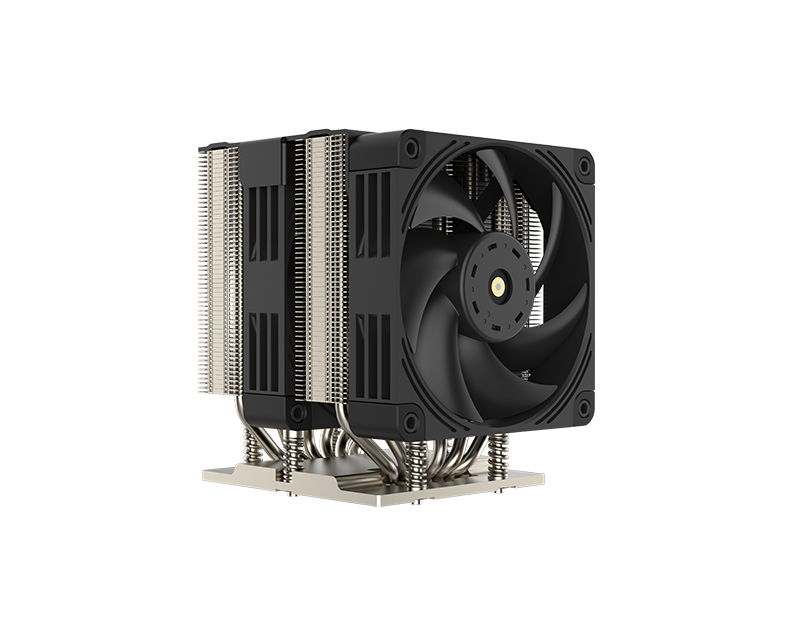
There are two main types of server CPU coolers: air coolers and liquid coolers. Air coolers are the most common and cost-effective option for server cooling, especially for 1U and 2U servers. These coolers feature a compact heatsink with multiple heat pipes and high-airflow fans, designed to dissipate heat efficiently in the limited space of a server chassis. For example, the Supermicro SNK-P0064AP4 is a 1U air cooler designed for Intel Xeon Scalable processors, featuring four 6mm heat pipes, a dense fin array, and a high-speed 40mm fan that delivers high airflow while maintaining acceptable noise levels. This cooler can handle TDP ratings of up to 205W, making it suitable for mid-range server CPUs.
Liquid coolers, including AIO (All-in-One) liquid coolers and custom loop systems, are becoming increasingly popular for high-performance servers, especially those with TDP ratings above 300W. Liquid coolers offer superior cooling performance compared to air coolers, as liquid is a better conductor of heat than air. AIO liquid coolers for servers are designed to fit in standard server chassis and feature a compact radiator, a pump, and one or more fans. For example, the Corsair ICUE H150i PRO XT is a 2U AIO liquid cooler that can handle TDP ratings of up to 300W, making it suitable for high-performance server CPUs. Custom loop systems are even more powerful, allowing for multiple radiators and coolants, but they are more complex and expensive, making them ideal for data centers and high-performance computing (HPC) environments.
One of the key challenges in server CPU cooling is dealing with high heat flux density. Server CPUs have a small effective heating area, leading to high heat flux density (heat per unit area). For example, a 900W CPU with an effective heating area of 7.84 cm² has an average heat flux density of over 100 W/cm², with local hot spots exceeding 300 W/cm². This makes it difficult for traditional air coolers to dissipate heat efficiently, as they have limited heat transfer capabilities. To address this, server coolers often use advanced technologies such as heat pipes with vapor chambers, which spread heat evenly across the heatsink, and microchannel cold plates, which increase the surface area for heat transfer.
Another important consideration for server CPU coolers is noise level. While servers are often located in data centers, where noise is less of a concern than in office environments, excessive noise can still be a problem, especially for small data centers or server rooms. Server coolers are designed to operate at high fan speeds to deliver sufficient airflow, but manufacturers use noise-reduction technologies such as low-noise fans, vibration-dampening materials, and optimized fan blade designs to keep noise levels in check. For example, the Noctua NH-U9S SE2 is a 2U air cooler that features a low-noise 92mm PWM fan, operating at a maximum noise level of 24.6 dB, making it suitable for noise-sensitive server environments.
Reliability is another critical factor for server CPU coolers. Servers are expected to operate continuously for years without failure, so the cooler must be highly reliable. Server coolers often feature redundant fans, which ensure that if one fan fails, the other fan will continue to operate, preventing the CPU from overheating. Redundant fans are especially important in mission-critical servers, where downtime can have severe consequences. Additionally, server coolers are tested to meet strict industry standards for reliability and durability, ensuring that they can withstand the harsh operating conditions of data centers.
When selecting a server CPU cooler, it is important to consider several factors, including the TDP of the CPU, the form factor of the server chassis, compatibility with the CPU socket, and reliability. The cooler must be able to handle the TDP of the CPU, ensuring that the CPU remains cool even under full load. It must also fit in the server chassis, with the correct height and width for the chassis form factor (1U, 2U, etc.). Compatibility with the CPU socket is also crucial, as server CPUs use specialized sockets (e.g., Intel LGA 4189, AMD SP3) that are different from consumer sockets.
Examples of popular server CPU coolers include the Supermicro SNK-P0064AP4 (1U air cooler, 205W TDP), the Noctua NH-U9S SE2 (2U air cooler, 250W TDP), and the Corsair ICUE H150i PRO XT (2U AIO liquid cooler, 300W TDP). For high-performance servers with TDP ratings above 300W, custom loop liquid coolers or advanced two-phase cooling solutions are often used. Two-phase cooling solutions, such as pulsating heat pipes or常压 two-phase cold plates, use the phase change of a coolant to dissipate heat efficiently, making them suitable for high-heat-flux server CPUs. These solutions can handle heat flux densities of over 400 W/cm², making them ideal for the next generation of 900W server CPUs.
In addition to selecting the right cooler, proper installation and maintenance are essential for ensuring optimal cooling performance and reliability. Server coolers should be installed correctly, with the thermal paste applied evenly to ensure efficient heat transfer. Regular cleaning is also important, as dust and debris can accumulate on the heatsink and fans, reducing airflow and cooling performance. Data centers often use compressed air or specialized cleaning tools to keep server coolers clean and free of dust.
Overall, a CPU cooler designed for server CPUs and high load cooling is an essential component for any server system. It ensures that the CPU remains cool and stable, even under continuous high loads, preventing downtime and ensuring reliable operation. By selecting a cooler that matches the TDP of the CPU, the form factor of the server chassis, and the reliability requirements of the application, businesses and organizations can ensure that their servers operate efficiently and effectively for years to come.
If you have any suggestions and comments on our products and services, please fill in the following table

No. 18, Liguang New Industrial Zone Liguang Community, Guanlan Sub-district Longhua District, Shenzhen
Copyright 2026 © Shenzhen Yuchuang Industry Co., Ltd. 粤ICP备16089648号




 Chinese
 CN
CN Home >