


 Mar 23, 2026
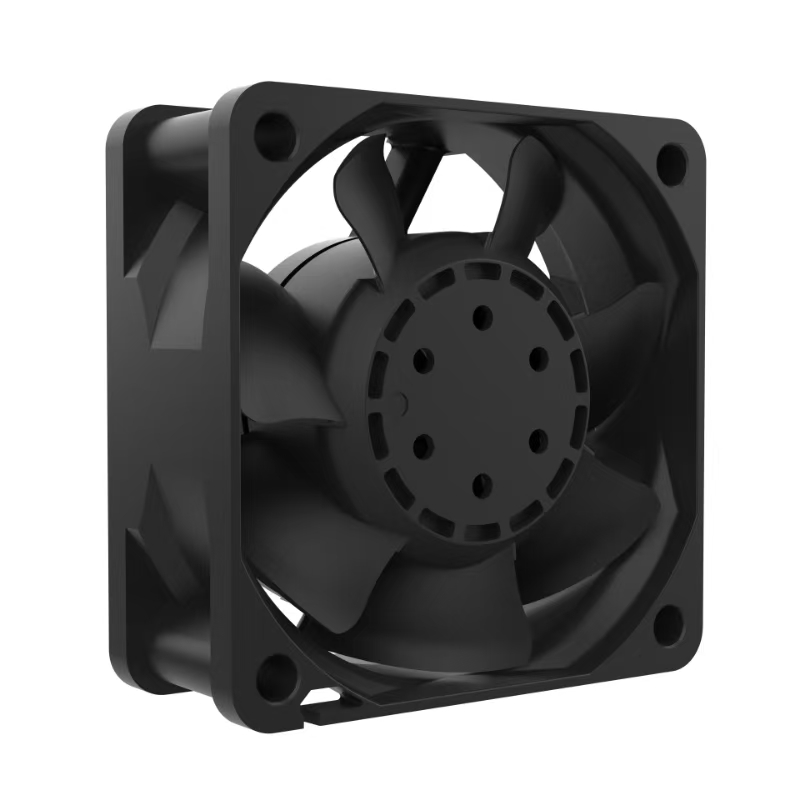
Long Life EC Fan is a high-reliability cooling product designed for scenarios that require long-term continuous operation, such as data centers, industrial automation equipment, power systems, and medical equipment. As the name suggests, its core competitive advantage is its ultra-long service life, which can reach 60,000 to 100,000 hours, far exceeding the service life of traditional AC fans (10,000 to 20,000 hours) and ordinary DC fans. This ultra-long service life is achieved through sophisticated structural design, high-quality material selection, and advanced manufacturing processes, making Long Life EC Fan an ideal choice for users who pursue low maintenance costs and high operational stability.
The key factor contributing to the ultra-long service life of Long Life EC Fan is its brushless DC motor design. Traditional AC fans use brushed motors, where the friction between carbon brushes and commutators during operation causes serious wear and tear. As the service time increases, the carbon brushes gradually wear out, leading to motor failure. In contrast, Long Life EC Fan adopts brushless DC motors, which use electronic commutation instead of mechanical commutation. This design completely eliminates the friction between carbon brushes and commutators, avoiding the most important wear part in traditional motors. The electronic commutation system is composed of solid-state electronic components, which have high stability and long service life, thus fundamentally improving the service life of the fan.
High-quality material selection is another important guarantee for the long service life of Long Life EC Fan. The impeller, motor shell, and other key components of the fan are made of high-strength, corrosion-resistant, and high-temperature-resistant materials. For example, the impeller is usually made of aluminum alloy or engineering plastic with high mechanical strength, which can withstand long-term high-speed rotation without deformation or damage. The motor shell is made of die-cast aluminum, which has good heat dissipation performance and corrosion resistance, protecting the internal components of the motor from the external environment. In addition, the bearings used in the fan are high-precision ball bearings or sleeve bearings with long service life, which can ensure the smooth rotation of the fan for a long time. These high-quality materials ensure that the fan can operate stably in harsh environments such as high temperature, high humidity, corrosion, and dust.
Advanced manufacturing processes and strict quality control also play an important role in ensuring the long service life of Long Life EC Fan. Manufacturers adopt precision machining technology to process the components of the fan, ensuring the accuracy and matching degree of each component. The assembly process of the fan is carried out in a clean and dust-free workshop, avoiding the impact of impurities on the fan's operation. In addition, each Long Life EC Fan undergoes strict testing before leaving the factory, including high-temperature aging test, long-term operation test, vibration test, and noise test. These tests ensure that the fan can meet the design requirements of long service life and stable operation, and eliminate unqualified products.
In addition to the ultra-long service life, Long Life EC Fan also has the advantages of high energy efficiency and intelligent control. Like other EC fans, it adopts a brushless DC motor, which has a high energy efficiency ratio, can save a lot of energy for users, and reduce operating costs. The fan is also equipped with an intelligent control system, which can automatically adjust the speed according to the actual cooling needs, further improving energy efficiency and reducing wear and tear. Some models also support remote monitoring and fault alarm functions, allowing users to grasp the fan's operating status in real time and deal with potential faults in a timely manner, ensuring the continuous and stable operation of the equipment.
The application scenarios of Long Life EC Fan are mainly concentrated in fields that require long-term continuous operation and have high requirements on equipment reliability. In data centers, where servers need to operate 24 hours a day, Long Life EC Fan provides stable cooling guarantee, avoiding fan failure leading to server overheating and data loss. In industrial automation production lines, the fan ensures the continuous operation of the production line by cooling the key equipment, improving production efficiency. In the medical field, it is used for cooling medical equipment such as MRI machines and CT scanners, ensuring the normal operation of the equipment and the accuracy of diagnosis. In the power system, it is used for heat dissipation of power distribution equipment and power generation equipment, ensuring the stable operation of the power grid.
When selecting Long Life EC Fan, users need to consider not only the service life of the fan but also factors such as air volume, static pressure, noise, energy efficiency, and control functions. It is also necessary to choose manufacturers with rich experience and reliable quality to ensure that the fan can truly meet the requirements of long-term stable operation. In addition, users should also pay attention to the maintenance of the fan during use, such as regular cleaning of the impeller and checking the operating status of the fan, which can further extend the service life of the fan.
In conclusion, Long Life EC Fan, with its ultra-long service life, high energy efficiency, and stable performance, has become an important part of the cooling system in many fields. It not only reduces the maintenance cost and replacement frequency for users but also improves the reliability and stability of the equipment. With the continuous development of industrialization and intelligence, the demand for high-reliability cooling equipment will continue to increase, and Long Life EC Fan will have a broader application prospect.
If you have any suggestions and comments on our products and services, please fill in the following table

No. 18, Liguang New Industrial Zone Liguang Community, Guanlan Sub-district Longhua District, Shenzhen
Copyright 2026 © Shenzhen Yuchuang Industry Co., Ltd. 粤ICP备16089648号




 Chinese
 CN
CN Home >