


 Jun 02, 2026
In the world of PC building, the CPU cooler is not just an accessory—it’s a critical component that directly impacts the performance, longevity, and stability of your processor. For users who demand consistent high performance, whether for gaming, content creation, or professional workloads, a CPU cooler equipped with 4 heat pipes stands out as a reliable and efficient choice. These coolers strike the perfect balance between cooling capacity, size, and affordability, making them a popular option for both mainstream and mid-to-high-end PC builds. This comprehensive guide dives deep into the technology, benefits, and real-world performance of high-performance CPU coolers with 4 heat pipes, helping you understand why they are a staple in modern PC setups.
First, let’s break down the core technology that makes 4-heat-pipe coolers so effective: heat pipes. Heat pipes are hollow copper (or occasionally aluminum) tubes filled with a working fluid (such as water or a specialized coolant) that leverages the principles of phase change to transfer heat efficiently. When the CPU generates heat, the fluid near the CPU (the evaporator section) absorbs the heat and vaporizes. The vapor then rises through the heat pipe to the condenser section, where it releases the heat to the surrounding air (via the cooler’s fins) and condenses back into a liquid. The liquid then flows back to the evaporator section via capillary action, creating a continuous, self-sustaining heat transfer cycle. This process is far more efficient than traditional heat sinks alone, as it allows for rapid heat dissipation even under heavy loads.
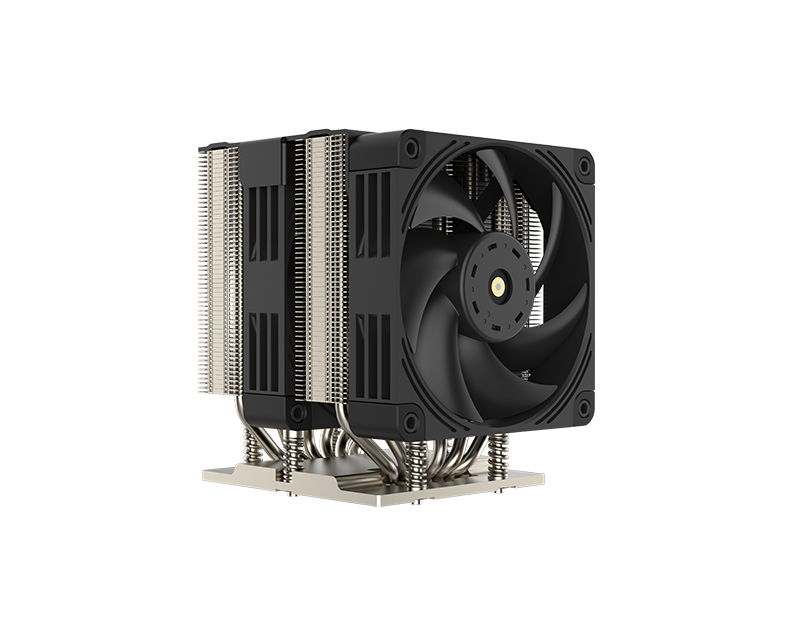
A 4-heat-pipe configuration is particularly effective because it provides an optimal balance between heat transfer capacity and physical size. Unlike coolers with 2 heat pipes, which may struggle to handle the heat output of modern mid-to-high-end CPUs (such as Intel’s Core i5/i7/i9 or AMD’s Ryzen 5/7/9), 4 heat pipes offer enough surface area and heat transfer capability to keep even powerful processors running at safe temperatures. On the other hand, coolers with 6 or more heat pipes often come with larger, bulkier designs that may not fit in smaller PC cases or may block other components (such as RAM or PCIe slots), making 4-heat-pipe coolers a more versatile choice for most builds.
High-performance 4-heat-pipe coolers typically feature additional design elements that enhance their cooling efficiency. One key feature is the direct-touch heat pipe design, where the heat pipes are flattened and polished to make direct contact with the CPU’s integrated heat spreader (IHS). This eliminates the need for a separate copper base, reducing thermal resistance and allowing for faster heat transfer from the CPU to the heat pipes. Many top-tier models also use nickel-plated heat pipes and fins to prevent corrosion and improve thermal conductivity, ensuring long-term performance and durability.
Another critical aspect of high-performance 4-heat-pipe coolers is the fin array design. The fins are typically made of thin aluminum sheets (or copper, for even better thermal conductivity) that are stacked closely together to maximize surface area. Some coolers use a “matrix fin” design, where the fins are arranged in a dense, overlapping pattern to increase airflow and heat dissipation. Others feature offset fins or cutouts to reduce air resistance, allowing fans to push more air through the fin array with less noise. The combination of 4 heat pipes and an optimized fin array ensures that heat is quickly transferred away from the CPU and dissipated into the air, even during prolonged high-load scenarios.
To put this into perspective, let’s consider real-world performance metrics. A high-quality 4-heat-pipe cooler, such as the DeepCool AK400, is capable of dissipating up to 220W of heat, which is more than enough to handle the heat output of most modern CPUs. For example, the AMD Ryzen 7 7700X has a TDP (Thermal Design Power) of 105W, while the Intel Core i7-13700K has a TDP of 125W (and can reach higher power levels under load). A 4-heat-pipe cooler can keep these CPUs running at temperatures between 60°C and 75°C under full load, which is well within the safe operating range (most CPUs can safely run up to 95°C, but lower temperatures improve longevity and performance). In contrast, a stock cooler (which often has only 1 or 2 heat pipes) may struggle to keep these CPUs below 85°C, leading to thermal throttling—where the CPU reduces its clock speed to prevent overheating, resulting in reduced performance.
Durability is another key advantage of high-performance 4-heat-pipe coolers. The copper heat pipes are typically soldered to the fin array, ensuring a strong bond that resists separation over time. Nickel plating not only prevents corrosion but also makes the cooler easier to clean, as dust and debris are less likely to stick to the smooth surface. Many models also come with a long warranty (5-6 years), a testament to their build quality and reliability. For users who plan to keep their PC for several years, a 4-heat-pipe cooler is a long-term investment that will continue to perform well even as CPUs become more powerful.
Compatibility is also a major consideration, and 4-heat-pipe coolers are designed to work with most modern CPU sockets. Whether you have an Intel LGA 1700, 1200, or 115x socket, or an AMD AM5 or AM4 socket, most 4-heat-pipe coolers come with a universal mounting kit that includes all the necessary brackets and hardware. This versatility makes them an ideal choice for PC builders who may upgrade their CPU or motherboard in the future, as the cooler can be reused with minimal effort.
When it comes to installation, 4-heat-pipe coolers are generally easy to install, even for beginners. Most models feature a tool-free mounting system or a simple screw-on design that can be completed in 10-15 minutes. Many also come with pre-applied thermal paste, eliminating the need to purchase and apply it separately. This ease of installation makes them a great choice for first-time PC builders who want a high-performance cooler without the hassle of complex setup.
In addition to their performance and durability, 4-heat-pipe coolers are also an affordable option. While high-end coolers with 6 or more heat pipes can cost $100 or more, most 4-heat-pipe coolers fall in the $40-$80 range, making them accessible to users on a budget. This affordability does not come at the expense of performance, as many mid-range 4-heat-pipe coolers outperform stock coolers and even some higher-priced models with fewer heat pipes.
To summarize, a high-performance CPU cooler with 4 heat pipes is an excellent choice for any PC build that demands consistent performance and reliability. Its optimal heat transfer capacity, versatile design, easy installation, and affordability make it a staple in modern PC setups. Whether you’re a gamer, content creator, or professional user, a 4-heat-pipe cooler will keep your CPU running cool and stable, ensuring that you get the most out of your hardware. When shopping for a 4-heat-pipe cooler, look for features like direct-touch heat pipes, nickel plating, an optimized fin array, and universal compatibility to ensure that you get the best possible performance for your money.
If you have any suggestions and comments on our products and services, please fill in the following table

No. 18, Liguang New Industrial Zone Liguang Community, Guanlan Sub-district Longhua District, Shenzhen
Copyright 2026 © Shenzhen Yuchuang Industry Co., Ltd. 粤ICP备16089648号




 Chinese
 CN
CN Home >